

Maintenance Debt – key indicators and measurement methods
Maintenance debt (maintenance backlog, deficit in physical asset management) arises when maintenance is not carried out as planned, in sufficient scope, or at the appropriate time. The consequence is a deterioration in the performance of equipment and systems relative to requirements.
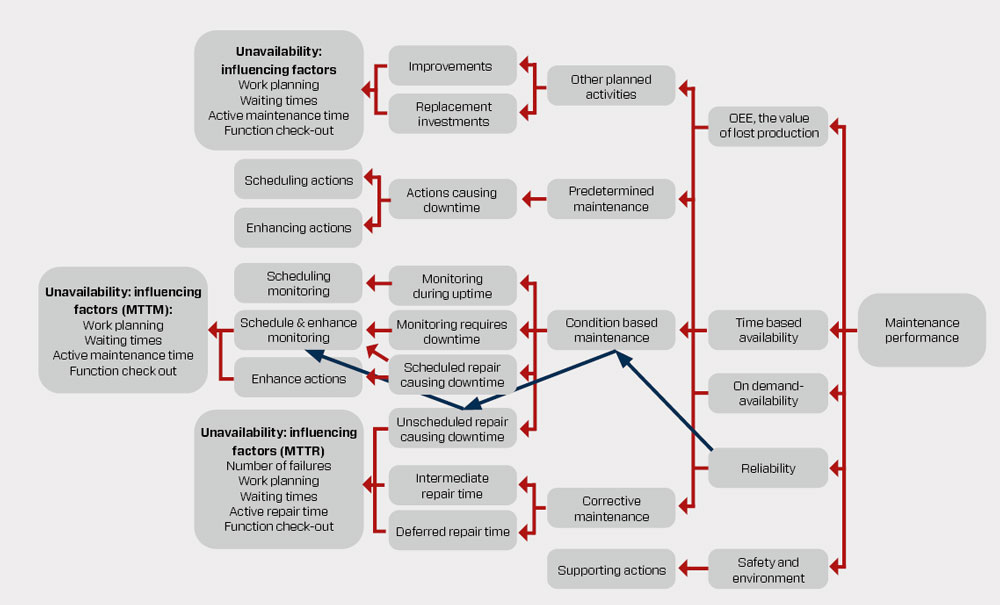
Diagnostic hierarchy of maintenance results (Komonen K. 2025. Thoughts on production asset management and maintenance leadership. Promaint).
Key indicators for identifying maintenance debt: in industrial environments, maintenance debt is most often detected by observing trends in key performance indicators rather than single point observations. A single indicator rarely reveals emerging or existing maintenance debt. Instead, individual indicators primarily act as triggers for more detailed investigations.
Debt arising during the procurement phase: Debt incurred in connection with investments can be assessed by comparing alternative options in terms of lifecycle returns and lifecycle costs. Options with low lifecycle returns and high lifecycle costs may indicate investment debt originated in the procurement phase.
Indirect, indicative conclusions can also be drawn from the financial evaluation methods applied in equipment acquisitions. If the required payback period is short (for example one year) and the evaluation method emphasises purchase price or internal rate of return (IRR), there is a risk that investment debt will be created.
Debt arising during the operating phase of physical assets: a comprehensive indicator that supports the identification of maintenance debt can be formed as a composite variable consisting, for example, of:
• unavailability costs
• maintenance costs
• capital costs of replacement investments
• energy costs
• equipment integrity and quality related costs
• other equipment-related lifecycle costs.
If the trend of this composite indicator is increasing, maintenance debt may be suspected. However, whether the increase indicates maintenance debt requires additional analysis. For example, over-maintenance may raise both maintenance costs and unavailability costs. Premature replacement investments may also increase total costs.
A decline in performance rate of the item may likewise indicate emerging maintenance or upkeep debt. Naturally, performance can deteriorate for many other reasons besides maintenance, such as design errors, installation errors, operational mistakes, or changes in usage patterns.
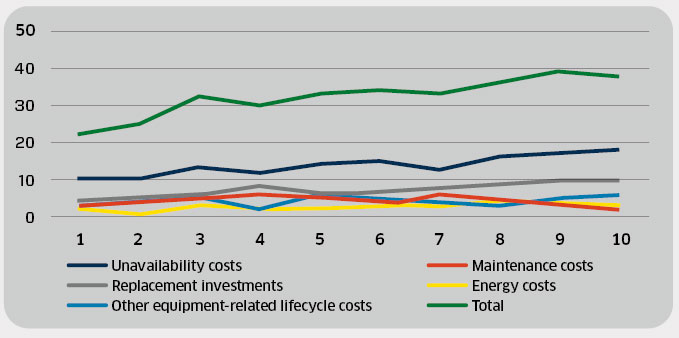
A comprehensive maintenance debt indicator (Komonen K. 2025. Thoughts on production asset management and maintenance leadership. Promaint).
Evaluation of maintenance debt using maintenance indicators:
if an organisation knows the optimal maintenance effort in relation to production volume or to the replacement value of assets, defining maintenance debt becomes considerably easier.
a) MOTBF (Mean Operating Time Between Failures) and/or unavailability costs
If requirements, strategies, operating profile, and operating conditions remain unchanged, a shortening of the failure intervallin sijasta MOTBF together with an increase in unavailability costs may indicate the emergence of maintenance debt.
b) Ratio of corrective to preventive maintenance
If the share of corrective maintenance increases while the share of preventive maintenance decreases in total maintenance, this may be a sign of maintenance debt developing. If preventive maintenance is deliberately reduced or reduced for other reasons (for example summer holidays, retirements, hurry, cost savings, or lack of resources), this may later manifest itself as maintenance debt.
c) Maintenance costs relative to replacement value of the equipment
This is one of the indicators for measuring maintenance efficiency and aging of the assets that also considers the size of the installed assets. It may indicate maintenance debt, but it must be reviewed together with the trend of unavailability costs. A decreasing value of the indicator can either reflect improved efficiency or, under otherwise similar conditions, an increased risk of maintenance debt.
d) Maintenance costs related to output
A reduction in maintenance cost per produced output generally indicates improved efficiency, assuming that production volumes, product mix, and prices remain roughly the same.
However, the interpretation should be complemented by examining repair times. Growth in total repair time (RT) and in mean repair time (MRT) often accompanies a shortening of MOTBF. An increase in the average repair time suggests that repair actions are becoming more demanding.
e) Cause–effect chains between indicators
Example: During the review period, the delivery reliability of a production line declined. At the same time, the total time allocated to planned condition-based maintenance decreased. This resulted from changes in the interval of condition monitoring measurements (i.e., measurements were performed less frequently). Consequently, unplanned condition-based shutdowns and failures increased, which further weakened delivery reliability. The outcome was maintenance debt.
It is difficult to develop a single, unambiguous indicator for maintenance debt. Using several indicators simultaneously provides a more reliable basis for conclusions.
Measurement methods and benchmarking:
Trend analysis and indicator combinations: in most cases, maintenance debt is identified by examining trends rather than individual values. One indicator alone is seldom sufficient. Therefore, organisations should define combinations of indicators whose joint information allows maintenance debt to be assessed. In addition, the procedures and rules for interpretation must be defined in advance.
Risk-based indicator: a risk-based indicator is founded on the organisation’s own risk assessment, which may rely on expert judgement. The assessment identifies events and assets that can cause unavailability, additional costs, or safety challenges. It also evaluates the consequences and severity of maintenance debt as well as the probability of its occurrence in different assets.
Benchmarking procedure: Benchmarking is an effective but often difficult method for assessing maintenance debt. Finding a sufficiently similar production unit is challenging, and even when one is found, competitive considerations frequently prevent meaningful comparisons.
Conclusions and practical considerations: Maintenance debt most often becomes visible through changes in key figures over time. Individual metrics mainly function as alerts that prompt deeper analysis.
Anticipating maintenance debt is inherently difficult because the future involves uncertainty. Nevertheless, defining suitable indicators, monitoring them systematically, and understanding their causal relationships supports proactive management.
When evaluating maintenance debt, it is essential to recognise the long-term effects of procurement choices, operational practices, and resource allocation on the development of physical assets.
Text: Janne Hakala, Juha Huitula, Mika Kari, Kari Komonen, Timo Lehtinen
Translation: Mia Heiskanen