
Case: Next-Generation Data Center Cooling Built on Polymer Flow Solutions
As data center operators increase rack densities and accelerate the adoption of direct liquid cooling, the requirements for cooling infrastructure are rapidly evolving.
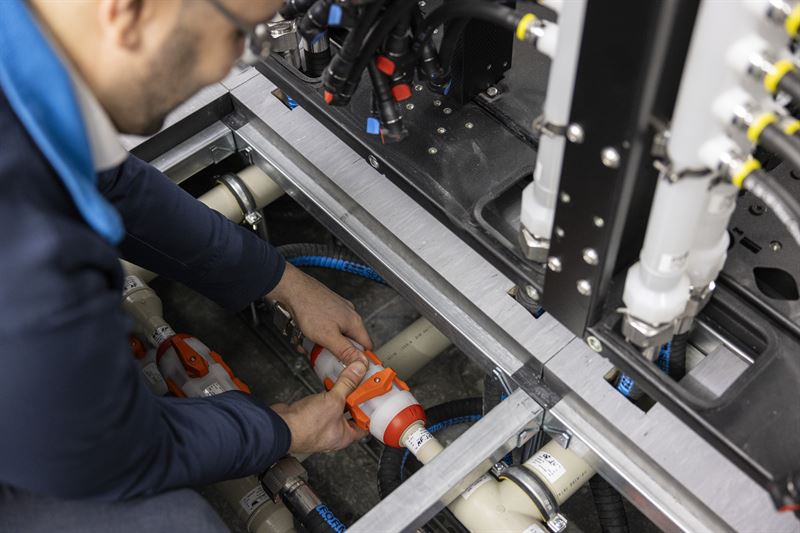
The Quick Connect Valve 700 is a patented dual-ball valve built from polyvinylidene fluoride (PVDF). The lightweight valve is engineered specifically for direct-to-chip liquid cooling requiring highes.
GF and Rittal have collaborated to deliver a fully integrated cooling solution for NETMOUNTAINS’ new colocation data center in Velbert, Germany.
GF supplied the entire polymer-based cooling loop for the project – from the chiller and dry cooler all the way to the rack and chip – covering the FWS, Technology Cooling System (TCS), and HVAC. Rittal serves as the complete solution provider for IT infrastructure and cooling equipment, integrating the full cooling ecosystem.
Designed for expansion
NETMOUNTAINS’ latest data center has been designed for maximum project flexibility, enabling seamless multi-megawatt scalability to grow in line with customer requirements. The cooling infrastructure is engineered to support these future demands, accommodating rack densities of 66 kW, flow rates of approximately 1.2 l/s per server, and operating temperatures of 45/55°C in the TCS and 45/35°C in the FWS.
“Our role is to bring all elements of the cooling ecosystem together into one reliable, integrated solution,” explains Felix Kremelic, IT Projects Lead at Rittal.
The cooling distribution unit delivers a cooling output of more than one megawatt in a compact rack format. Its modular design allows easier integration into data centers during live operations.
Why polymers matter in modern data centers
As direct liquid cooling gains broader adoption, polymers are increasingly replacing metal in mission-critical cooling loops. Unlike metal piping, engineered thermoplastics are inherently corrosion-free and do not release particles into the coolant, helping maintain coolant purity and significantly reducing system rinsing requirements.
In addition, polymer systems offer lower weight, high chemical resistance, and lower thermal conductivity, supporting stable and efficient cooling performance. Welded polymer connections ensure long-term leak tightness and reliable operation, making them well suited for modern CDUs and high-performance computing (HPC) environments.
“Increasing rack densities and the wider adoption of direct-to-chip liquid cooling are fundamentally changing the requirements for data center cooling infrastructure,” says Ergin Sarac, Data Center Specialist at GF.
“Instead of isolated systems, operators need fully integrated cooling loops,” explains Ergin Sarac.