
Local Water Supply Crucial to the Success of Europe’s Hydrogen Initiative
Large-scale green hydrogen production requires sustainable water management to prevent local shortages and potential conflicts with agriculture over access to resources.
Photo: Joachim Pressl / Unsplash
A new study from Chalmers University of Technology shows that careful planning of hydrogen production sites, combined with appropriate technology choices, will be essential to ensure that large-scale deployment does not create water stress in parts of Europe.
The study, published in Nature Sustainability, explores different scenarios for how Europe’s hydrogen production could affect water resources, electricity prices, and land use by 2050 – a milestone year for many countries’ carbon reduction commitments and potential widespread adoption of hydrogen technologies.
“We can show that even if hydrogen production does not require very much water in total compared to say agriculture, the local effects can be significant. This is because it’s better to produce hydrogen in close proximity to industry and access to renewable electricity, which generally means areas where water resources are already under strain,” says Joel Löfving, doctoral student at the Division of Transport, Energy and Environment at Chalmers.
Sörmland and Roslagen are high-risk areas
For Sweden, it is anticipated that the water supply in the Sörmland and Roslagen regions, for example, is going to be hard pressed even without hydrogen production in 2050.
“In Sörmland there is already a steel mill and a refinery. If they were to switch to hydrogen and use local water sources to produce it, this could exacerbate the projected water shortage."
"Also in the Roslagen region northeast of Stockholm, we can see that it might be difficult to source local water for the production of green hydrogen, and in the Bohuslän region on the Swedish west coast, and parts of Norrland in the north, large-scale hydrogen production could increase water withdrawal by more than 50 per cent."
"Although the water supply there is considered to be good, there is a risk that this production could have a significant impact on the natural environment”, Löfving says.
Over 700 Water Sub-Basins Analysed Across Europe
The study analysed more than 700 local water sub-basins across Europe. Similar patterns to those identified in Sweden were found in several other regions. In southern and central Europe, where strong solar and wind resources make green hydrogen production particularly attractive, access to water is projected to be highly constrained by 2050 due to existing stress and climate change impacts.
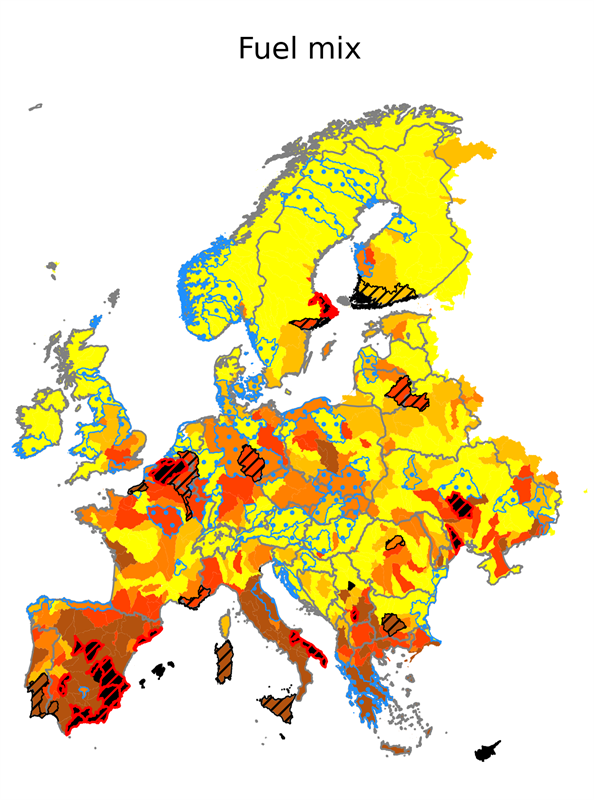
Map of a simulated risk of water stress in 2050 where hydrogen is used in transport and industry. Baseline risk (regardless of hydrogen use) is represented by the background color in each area. Dashed areas show water use exceeding available resources due to hydrogen production. Blue dots show areas where the risk of water stress increases by more than 50 percent in the simulation. Illustration: Chalmers University of Technology / Joel Löfving
Major industrial clusters in Spain, Germany, France, and the Netherlands could therefore face conflicts with agriculture and other sectors over water use.
“There are many potential conflicts around water as a resource, but also many solutions, such as seawater desalination or the reuse of water from wastewater treatment plants. There are also interesting synergies, as the oxygen that remains from the hydrogen production could be used in the processes that treat the wastewater. Hydrogen has great potential to contribute to the climate transition, but we need to find sustainable ways to manage water resources – for the production of fuel and for agriculture,” says Löfving.
Limited Impact on Electricity Prices
In addition to water use, the researchers assessed how a large-scale hydrogen economy could influence Europe’s electricity prices. By integrating their hydrogen model into Chalmers’ Multinode energy system model, they estimated regional price changes under different scenarios.
Electricity demand increases substantially with hydrogen production, as replacing fossil fuels requires significant electrical input. Despite this, the study shows that the impact on average European electricity prices remains relatively modest.
Regions with strong access to renewable energy, such as northern Europe, experience the smallest price effects. In contrast, some southern European regions with greater reliance on gas or nuclear generation could see larger price increases.
Balancing System-Level Trends and Local Impacts
Large-scale green hydrogen production would require significant expansion of solar and wind power capacity. However, the study estimates that the additional land use would account for only a few percent of the land currently used for agriculture – considerably less than what would be needed to generate the same energy through biofuels.
Previous research has typically focused either on local impacts or on broader system-level effects. This study combines both perspectives.
“If we are going to build the future’s energy system, we need to understand both the broad patterns and the local consequences. By considering risks, we will be able to manage them, and thus create more certainty for investments in green technology,” says Löfving.
About the Research
The study, “Resource requirements and consequences of large-scale hydrogen use in Europe,” was published in Nature Sustainability. The authors are Joel Löfving, Selma Brynolf, Maria Grahn, Simon Öberg, and Maria Taljegard, all affiliated with Chalmers University of Technology. The research was conducted within the competence centre TechForH2 and the Division of Transport, Energy and Environment in collaboration with the Division of Energy Technology.